
Checking Criminal History in Cochran County
No one database holds a full Cochran County criminal history. Start with the combined district and county clerk when the goal is a filed charge, docket, judgment, or sentence. The clerk can check both felony matters in the 286th District Court and county-level misdemeanors. Start with the sheriff's jail report when the question is current custody or a recent booking. Use the Texas Department of Public Safety only for the statewide public product, which reports convictions and deferred adjudications submitted to DPS. Each source has a different time frame and legal purpose.
Gather a full legal name, any prior name, an approximate arrest or filing year, and the cause or booking number if one is known. A date of birth may help an office distinguish two people with the same name, though the custodian decides what can be accepted or released. Match the court, charge, and date before treating a result as the right person. Cochran County records can use a police report number, booking identifier, court cause number, and DPS tracking number for the same event.
- Ask the Cochran County clerk to identify the court, cause number, filing date, charge, and current disposition.
- Check the official jail report for current inmates, the prior 24 hours, or entries organized by arrest date.
- Search the DPS conviction system with enough identifiers to reduce a false name match.
- Compare the arrest or repository result with the latest signed court order in Cochran County.
- Request a certified judgment from the clerk or a fingerprint self-review when formal identity proof is needed.
Cochran County's Five Record Keepers
Cochran County concentrates much of its justice system inside the courthouse at 100 North Main Street in Morton, yet custody remains divided. The combined clerk in Room 102 keeps district and county court files. The sheriff works from Room B-7 and handles jail, booking, and sheriff incident records. The 286th District Court sits in Suite 205. The county attorney and Adult Probation Department share Room 204, while the countywide justice of the peace is in Room B-4. Close doors do not mean one shared index.
The official Cochran County directory is the useful starting map for those offices. Its courthouse view also shows why a caller should name the record, not merely ask for a background check. The image below comes from that county contact hub.
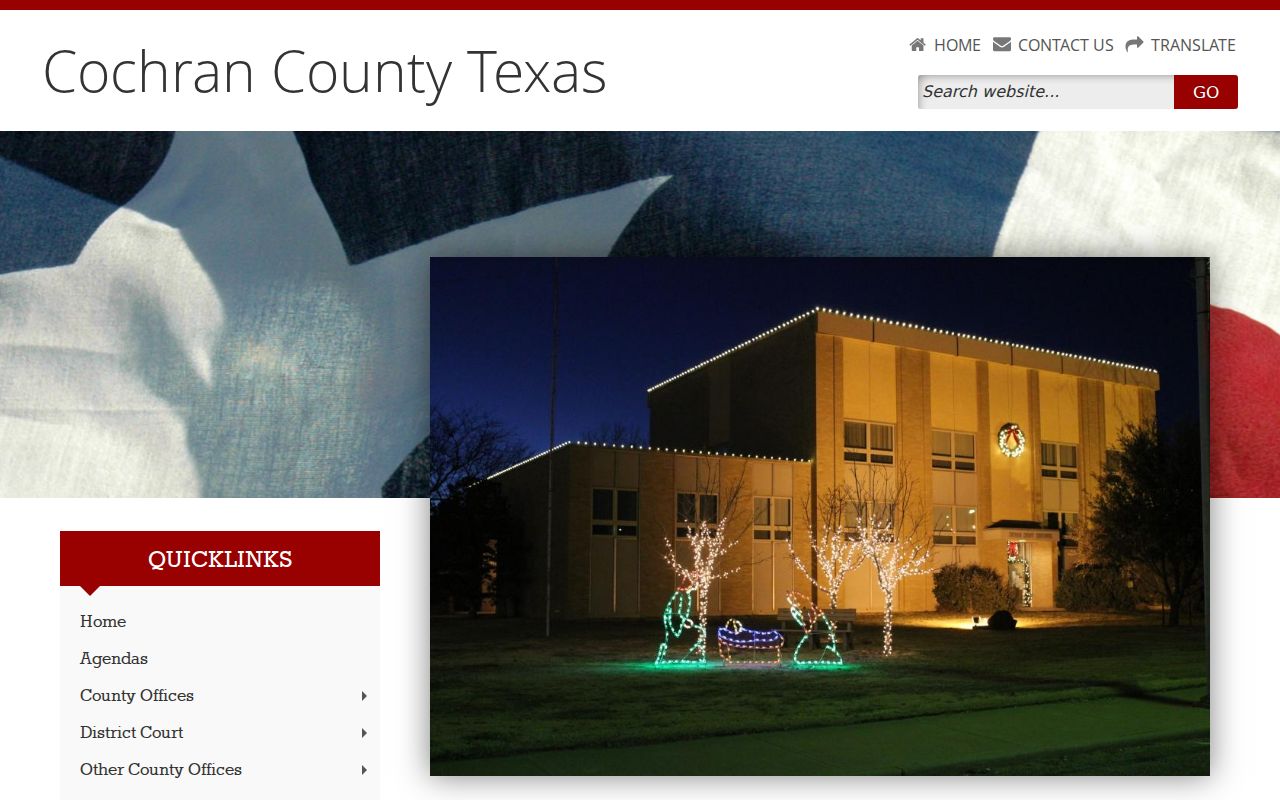
The clerk, sheriff, court, prosecutor, and supervision office may all touch one event, but only each custodian can certify its own Cochran County record.
Combined District and County Clerk
Room 102, 100 N. Main St., Morton, TX 79346
806-266-5450
Monday through Thursday, 8 a.m. to noon and 12:30 to 5 p.m.; Friday, 8 a.m. to 2 p.m.
Cochran County Sheriff
Room B-7, 100 N. Main St., Morton, TX 79346
806-266-5211
Lobby and records hours are not posted; call before visiting.
286th District Court
Suite 205, 100 N. Main St., Morton, TX 79346
806-266-5412
The court also maintains an administrative office in Levelland.
Texas Official Background Checks
Texas DPS Crime Records Division offers two official paths that serve different needs. The public Criminal History Conviction Name Search can be used after opening an account and buying credits. It reports public Texas convictions and deferred adjudications that agencies sent to DPS. It is not a national history, and it may omit an arrest with no public disposition. A person reviewing their own record can use the fingerprint route through Fingerprint Applicant Services of Texas, delivered by IdentoGO and IDEMIA.
Fingerprints tie the request to one identity and are more dependable than name matching. DPS lists a $15 fingerprint-based record-review fee plus a $10 FAST fingerprint fee. Two hard cards cost $20, and a law-enforcement agency may charge up to $10 per card. No fixed IdentoGO site was verified inside Cochran County, so the appointment search should be run with a current Morton-area location and date. The official FAST appointment page pictured below is the place to check current availability.
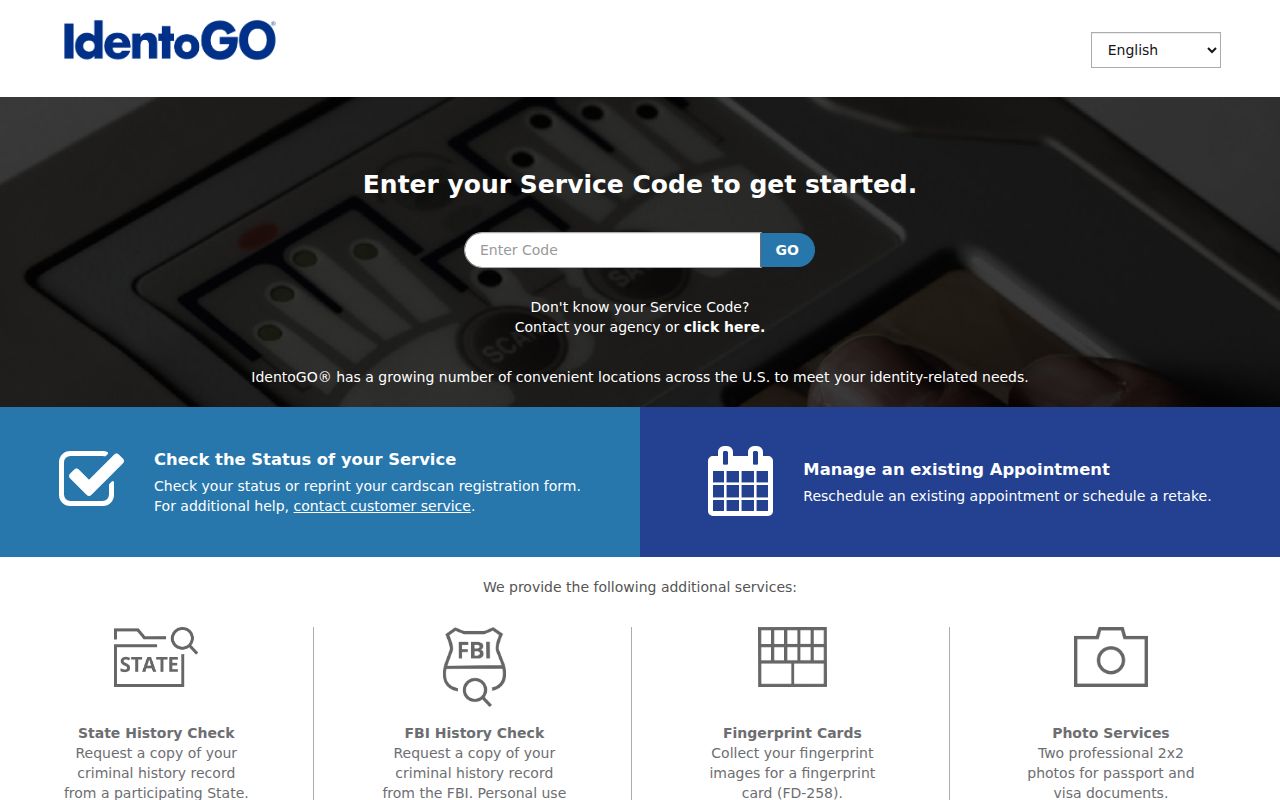
The appointment system, rather than an unverified private storefront, supplies the current site and instructions for a Cochran County fingerprint review.
Cochran County DPS Search Risks
The DPS public name search is helpful when the goal is a reported Texas conviction or deferred adjudication, but every query consumes a credit even when it returns no record. Credits cost $1 each. Card purchases add a 2.25 percent fee per credit and a 25-cent transaction fee, while DPS says check purchases avoid those card surcharges. The agency FAQ also lists $10 for an offline name check. Those prices cover repository searches, not copies from the Cochran County clerk.
The DPS conviction name-search interface accepts name data and other filters after account access. Its main screen is shown below.
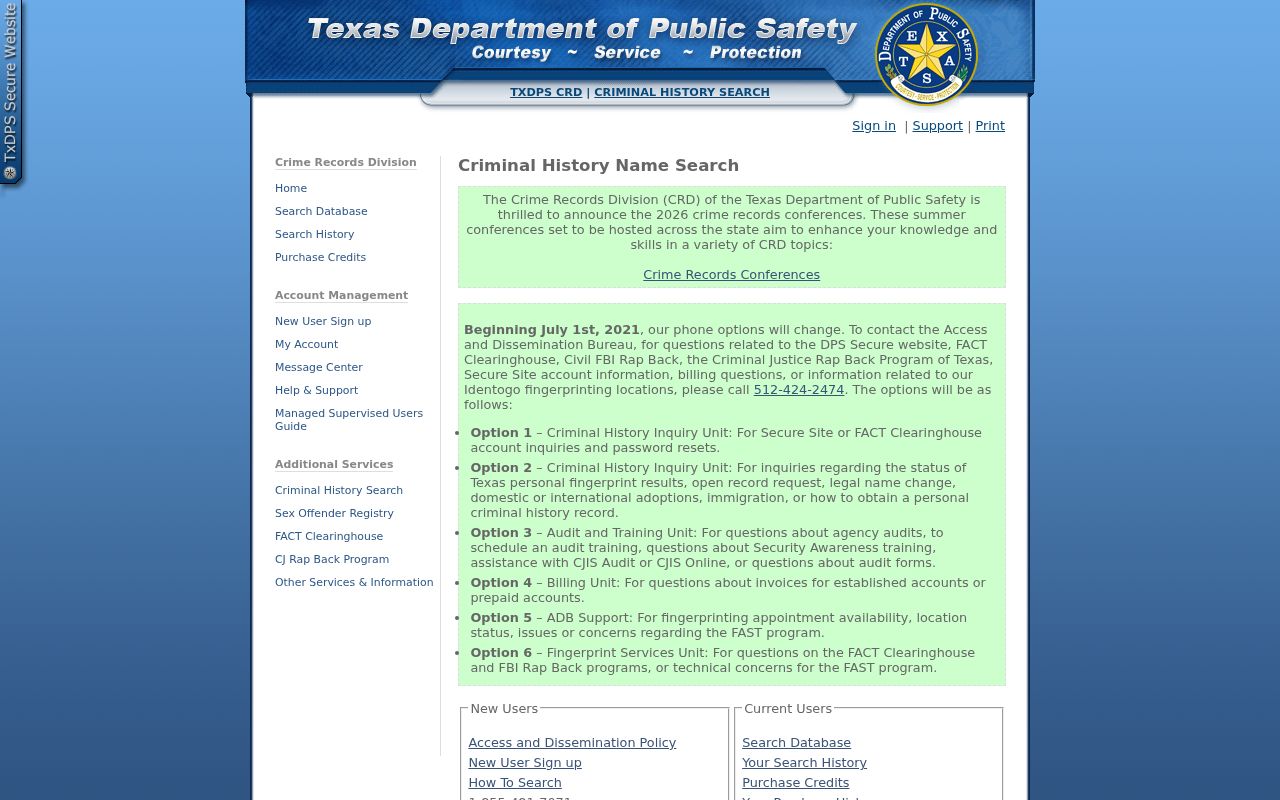
A close name match can belong to someone else, and a spelling variation can hide the intended result. Confirm a DPS candidate against the Cochran County court judgment before relying on charge or disposition details.
| Search field | Use | Important limit |
|---|---|---|
| Last and first name | Required name match | Common names can return candidates |
| Middle name | Narrows a match | Optional |
| Date of birth | Strong identity clue | Availability can depend on portal view |
| Sex and race | Additional filters | Options depend on the search control |
| Exact-match control | Changes name logic | Similar-sounding and exact spelling differ |
The official DPS help and pricing page explains credits and search requirements. Its guidance screen appears below.
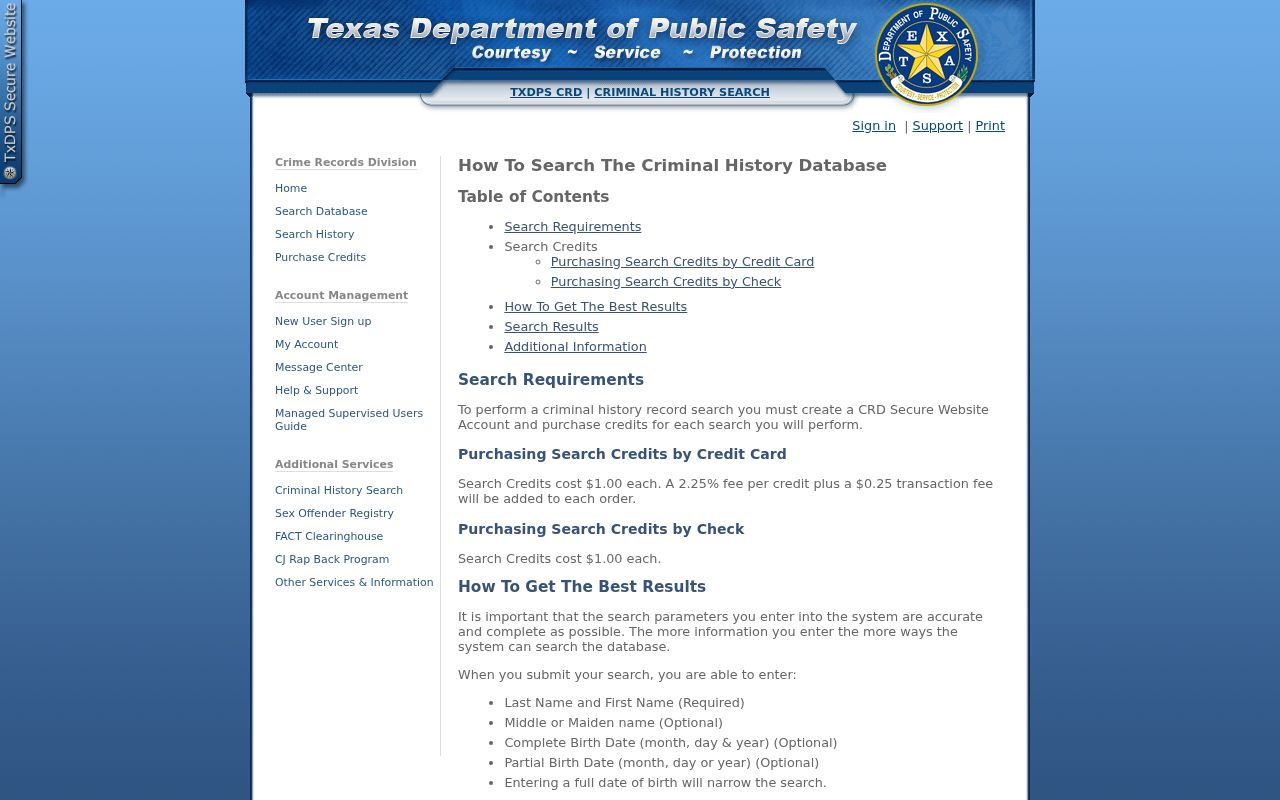
DPS warns that repository data depends on Texas agency submissions, so a local signed disposition remains the best way to settle a Cochran County case outcome.
Criminal Record Types
A Cochran County arrest can create several records, each organized under a different number. The arresting agency writes an incident or arrest report. The jail creates an intake record when custody occurs. A prosecutor may then file a complaint, information, or indictment, and the clerk opens a court file under a cause number. DPS builds a repository cycle from fingerprints and later disposition reports. A warrant, supervision entry, prison record, or registry profile adds another record without replacing the earlier ones.
Ask for the product that answers the question. The sheriff can provide public portions of a booking or sheriff incident report. The combined clerk holds Cochran County court pleadings, docket entries, judgments, and sentences. DPS provides the statewide public conviction and deferred-adjudication result. TDCJ covers a sentenced state prisoner, while the Texas Public Sex Offender Registry covers statutory registration data. None should be described as a complete substitute for all the others.
- Arrest and booking records: show an allegation and jail intake, not guilt.
- Criminal court case files: show filed charges, proceedings, disposition, and sentence.
- DPS history entries: compile reported Texas arrest cycles and public qualifying outcomes.
- Warrant records: identify a court command or arrest authority and may be split by court.
- Supervision and registry records: reflect separate probation, parole, or Chapter 62 duties.
Cochran County Custody Records
The Cochran County Jail Report is the official first check for local custody. It offers Current Inmates, 24 Hours Arrests, and Inmates by Arrest Date views, plus an optional name filter. A result can show arrest date, agency, days in jail, total bond, charge lines, warrant numbers, and custody status. The sheriff links the report from its official county page. A missing entry is not proof that no arrest occurred because a release, transfer, intake delay, or older booking can put the record elsewhere.
A person transferred to state prison may no longer appear on the Cochran County roster. Use the TDCJ Inmate Information Search for Texas prison custody or release-related status, and the Bureau of Prisons locator for federal custody. VINELink can provide custody notifications, but it is not a warrant or criminal-history database. For the full channel and booking-field details, see the Cochran County arrest lookup.
| Record need | Official channel | What it does not prove |
|---|---|---|
| Current county custody | Cochran County Jail Report | Guilt or final charge |
| Texas prison status | TDCJ Inmate Information Search | Current county booking |
| Federal prison status | BOP Inmate Locator | Texas court disposition |
| Custody notification | VINELink | A complete case record |
Inside a Cochran County Criminal Record
A full fingerprint-linked Texas history is built around identity and arrest cycles, while the public DPS product is narrower. It may include legal and alias names, a State Identification number, an FBI number when assigned, arresting agency, arrest date, tracking control number, alleged offenses, court action, disposition, and sentence. A Cochran County court file is instead arranged by cause number and docket. The jail report is arranged around intake and charge lines. Bond, fine, court costs, and restitution arise at different stages and should not be blended.
Read status words with care. A dismissal ends a charge without a conviction but does not erase the arrest. Deferred adjudication postpones a final finding of guilt while supervision is completed under Texas law. An acquittal is a not-guilty outcome. A conviction is a judgment of guilt, though an appeal or later order may change what appears to be final. Always ask the Cochran County clerk for the latest signed order when a docket has later activity.
| Name and identifiers | Legal or alias names, birth information, SID, FBI number, and fingerprints where authorized. |
|---|---|
| Arrest and booking data | Agency, date, tracking or booking data, alleged offenses, bond, and release or custody status. |
| Charges and statutes | Complaint, information, or indictment language and the cited Texas offense provision. |
| Disposition | Dismissal, acquittal, deferred adjudication, conviction, or another filed outcome. |
| Sentence | Confinement, fine, costs, restitution, credit, and special findings in the signed judgment. |
| Custody or supervision | County jail, TDCJ, community supervision, parole, or later revocation events when reported. |
Cochran County Court Search Limits
The Texas Office of Court Administration identifies the combined Cochran County clerk as a NetData user and confirms that the office accepts criminal filings. That vendor name does not establish a public case-search site. The county advertises an online land-record service, but it is not a criminal docket. No public Cochran County criminal case portal was located in the official county pages. Sending a reader to the land portal would produce the wrong record type.
re:SearchTX is an official statewide electronic court system, yet the Texas Judicial Council reported that its broad public document collection excludes criminal case records. It cannot replace the clerk for a Cochran County felony or misdemeanor file. Call Room 102 with a name, cause number, and filing range. Ask for the index result first, then request the docket sheet, judgment, or other specific document. The Cochran County criminal court case records identify each local court and the direct clerk workflow.
Note: A portal brand in an office directory is not proof that the public can search that office's criminal index online.
Public Access Laws in Texas
The Texas Public Information Act governs many Cochran County agency records, but court case files follow court-record law and clerk practice rather than ordinary TPIA handling. A request does not need special wording. It does need enough detail for the office to locate an existing record. Texas law preserves basic information about an arrested person, arrest, or crime in many cases while allowing investigative material to be withheld when release would interfere with enforcement. Other statutes protect juvenile files, victim identity, private identifiers, expunged material, and records covered by nondisclosure.
DPS criminal-history data has separate dissemination rules. The public may obtain the conviction and deferred-adjudication information allowed through the state name search, but broader criminal-history information is confidential except for authorized releases. Registry information is mostly public under Chapter 62, subject to exclusions for victim identity and sensitive personal data. These laws define access; they do not turn a public record into permission to threaten, harass, or misuse a person's information.
Key Statutes:
Government Code Chapter 552 grants access to public information and sets law-enforcement exceptions.
Government Code Chapter 411 controls DPS criminal-history access and orders of nondisclosure.
Code of Criminal Procedure Chapter 55A governs expunction of qualifying arrest records.
Code of Criminal Procedure Chapter 62 governs sex offender registration and public registry data.
Cochran County Sheriff Record Requests
Cochran County does not advertise a branded sheriff records division or an online request form. The direct official fallback is Sheriff@co.cochran.tx.us for an Open Records Request. Describe the report, booking, jail record, or other item; give an approximate date and location; add an incident or booking number if known; and state the preferred electronic, paper, or inspection format. Ask for a cost estimate before copies are made. The sheriff has not posted a local copy schedule, identification rule, or delivery promise.
The Cochran County sheriff page links the jail report and provides the official email, phone, and fax routes. The same office may hold a sheriff incident record and a county booking record, but a Morton Police Department or Texas DPS report stays with the agency that made it.
| Record description | Name the incident, arrest, booking, jail record, or other existing item. |
|---|---|
| Date and place | Use an event date or range and the location to narrow the search. |
| Known number | Add an incident, case, or booking identifier when available. |
| Delivery choice | Ask about electronic delivery, paper copies, or in-person inspection. |
| Cost | No Cochran County sheriff fee schedule was located; request a quote first. |
Cochran County Warrant Records
Cochran County publishes no public warrant name-search portal, dedicated warrant phone line, sheriff app, or current most-wanted page. The correct channel depends on the issuing court. Ask the combined clerk about felony and county-misdemeanor case warrants, the countywide justice of the peace about justice-court warrants and capias pro fine matters, and Morton Municipal Court about a city citation or municipal warrant. The jail report shows people already booked, not everyone with an active warrant. Law-enforcement TCIC and NCIC systems are not public databases.
A warrant is a court command or arrest authority, not a conviction. Ask for the warrant or capias number, related cause number, alleged offense, issuing court, bond, and current status. The issuing clerk is the best source for recall confirmation after a court resolves it. Charge level also controls where the related case goes: fine-only Class C matters can remain in justice or municipal court, Class A and B misdemeanors generally reach the County Court, and felonies reach the 286th District Court. Enhancements or later filing choices can change the level first shown at booking.
- Arrest warrant
- Directs a peace officer to take the named accused person into custody.
- Capias
- A court writ directing arrest after a procedural event such as charging or nonappearance.
- Capias pro fine
- Post-judgment process used to enforce an unpaid fine and costs.
- Search warrant
- Authorizes a search of a place or property and may remain sealed during an investigation.
Sealed, Expunged, and Restricted Records
Texas now places expunction law in Code of Criminal Procedure Chapter 55A. An expunction addresses records tied to a qualifying arrest and directs named agencies to return, destroy, or otherwise dispose of covered material as the statute and order require. An order of nondisclosure works differently. It restricts ordinary public release of eligible criminal-history information but does not destroy the record, and criminal-justice agencies plus entities named in Government Code Chapter 411 may retain access.
Eligibility depends on the offense, charge outcome, waiting period, criminal episode, prior history, and the exact statutory path. Cochran County does not publish a local expunction packet or current filing fee. The combined clerk can confirm venue, filing method, local cost, and whether the underlying matter was a county, district, or municipal case. Juvenile files, protected victim data, private identifiers, sealed material, and some supervision details also may not appear in a public Cochran County criminal record search.
| Texas remedy | Main effect | Cochran County starting point |
|---|---|---|
| Expunction | Removes or destroys covered arrest records as ordered | Confirm the Chapter 55A route and venue with the combined clerk |
| Nondisclosure | Limits ordinary public release without destroying the record | Use the clerk that handled the eligible case |
| Juvenile restriction | Applies separate confidentiality and sealing rules | Do not expect the adult jail or public DPS search to expose the file |
Cochran County Court Record Split
A Cochran County felony can involve two cities without moving its official file out of the county. The 286th District Court hears felony cases for Cochran County. Its Morton contact is in the courthouse, while the judge and court coordinator also use an office at 802 Houston in Levelland. The district attorney is based in Levelland as well. The combined clerk in Morton still keeps the Cochran County filing, docket, and judgment.
This split often sends requests to the wrong desk. Prosecutors assess charges and represent the State, but they do not replace the clerk as custodian of filed court papers. Ask the district attorney about a prosecutor-held record or victim-process matter. Ask the clerk for the cause file, signed order, and certified disposition. County-level prosecution is associated with the Cochran County attorney in Morton. No standalone county public defender office is published; appointed counsel is requested through the court.
Note: A Levelland prosecutor address does not mean a Cochran County felony judgment is filed with a Hockley County clerk.
Cochran County Supervision Records
Texas calls probation community supervision. Cochran County's Adult Probation Department, or Community Supervision and Corrections Department, works from Room 204 of the Morton courthouse and can be reached at 806-266-5074. A public name-search portal for local supervision was not located. The court judgment and docket are the sound first sources for a community-supervision term, deferred adjudication, motion to revoke, or motion to adjudicate. Operational supervision files can contain testing, treatment, and personal data that is not public.
The official Cochran County adult probation page identifies the local office. Its posted contact view appears below.
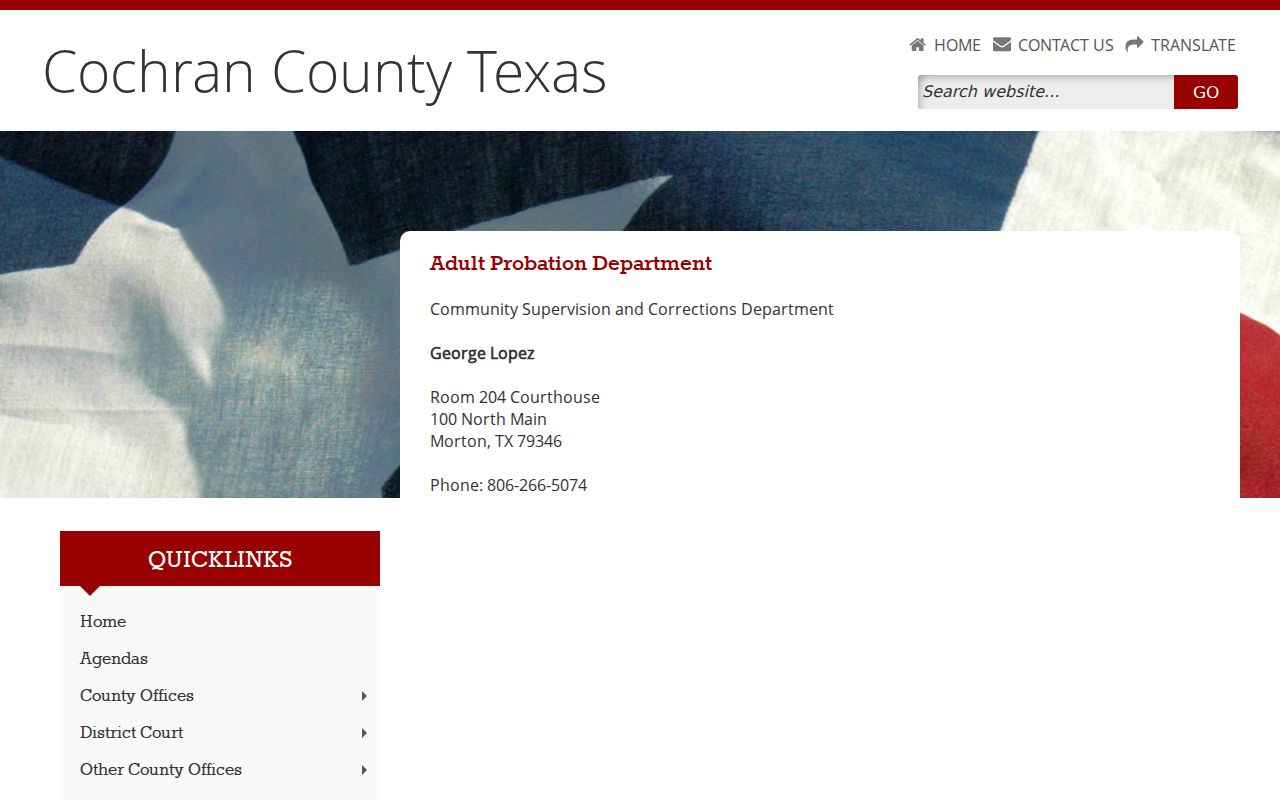
The local department supervises court-ordered community supervision; it does not make state parole release decisions.
Parole follows a Texas prison sentence. The Texas Board of Pardons and Paroles makes release and revocation decisions, while the TDCJ Parole Division supervises people released on parole or mandatory supervision. The official Texas parole authority page shown below explains that statewide role.
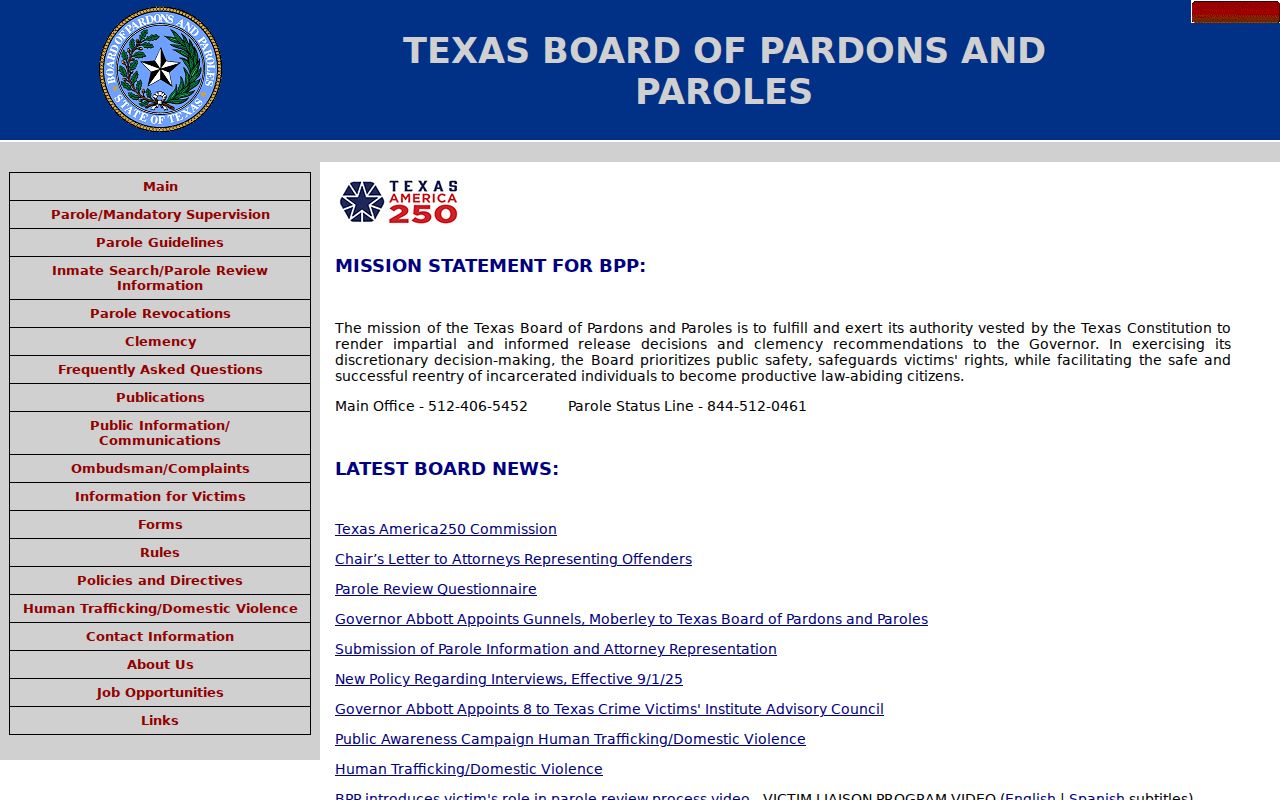
TDCJ assigns Cochran County to the Lubbock District Parole Office in Region V, so current street details should be checked in the live state directory before a visit.
Cochran County Criminal Records by City
Cochran County has only two incorporated places: Morton and Whiteface. Bledsoe is a named community but is not an incorporated city in the current Census place file, so it is not used to pad the list. Morton has a city police and municipal-court channel, though no public city case portal was found. Whiteface has an official municipal-court phone and mailing route but no verified standalone police records unit or town website. City records must be routed by the agency and court that actually created them.
The population figures use different official vintages. Morton has a 2024 city population of 1,712 in the state judiciary report, while Whiteface has a verified 2020 Census count of 375. That difference does not affect their clear first and second rank. The city-specific records cover local incident, citation, municipal case, and booking paths, with county records routed back to Morton.
Morton Criminal Records
1,712 residents in the 2024 OCA figure · city police, City Hall records routing, and municipal court at 201 E. Wilson.
Whiteface Criminal Records
375 residents in the 2020 Census · municipal court phone and mail routing with the sheriff as a verified county fallback.
Federal Records Beyond Cochran County
Cochran County lies in the Lubbock Division of the U.S. District Court for the Northern District of Texas. A federal prosecution is separate from the 286th District Court file. PACER is the official federal docket system for unsealed filings, hearing entries, orders, judgments, parties, and counsel. The federal clerk in Lubbock can address courthouse access. County staff cannot certify a federal docket, and a PACER result should not be described as a Cochran County court case.
The official PACER portal pictured below requires an account and applies its federal fee policy. Sealed cases and protected data remain unavailable.
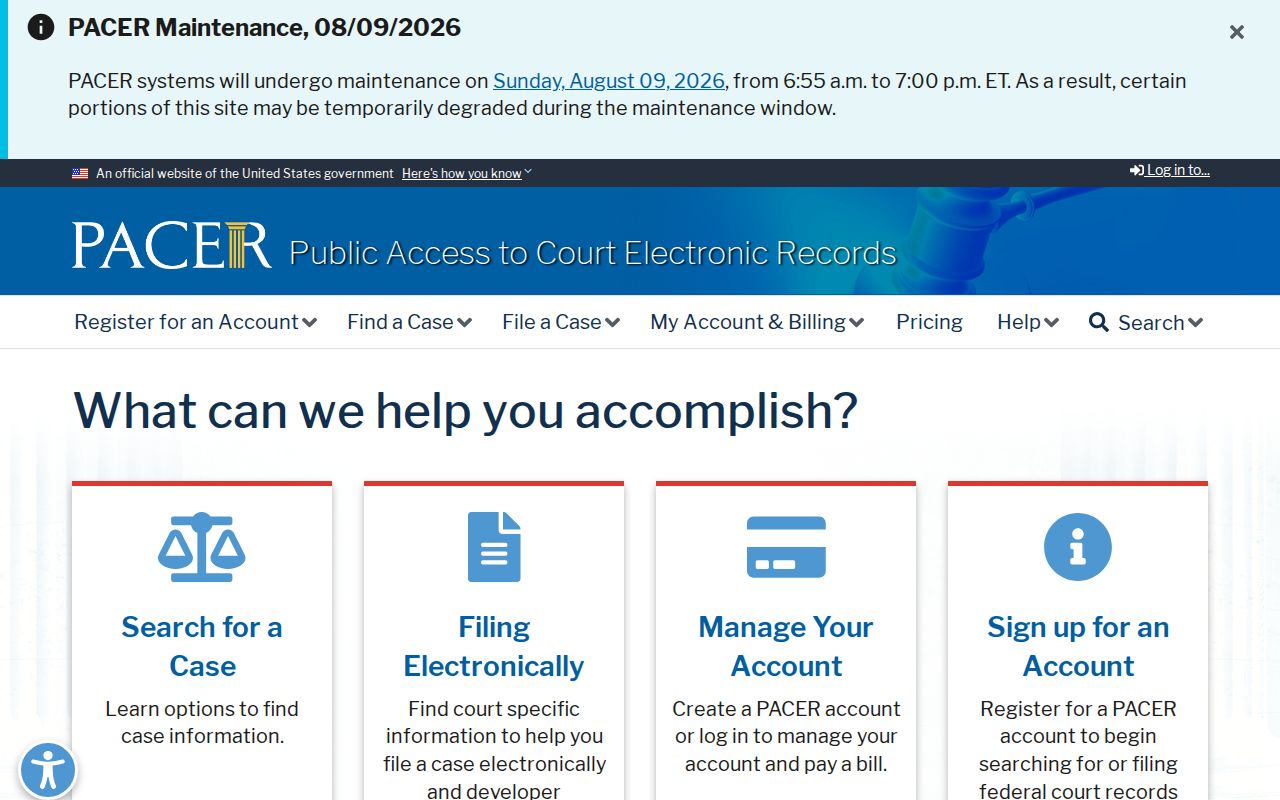
Use the FBI fingerprint Identity History Summary only to review one's own federal identity history, and use the Bureau of Prisons locator only for federal custody. Neither tool replaces a Cochran County clerk or sheriff record.